


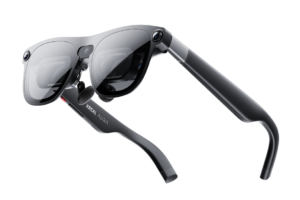
XREAL has officially announced the XREAL Aura (XREAL store on Amazon), marking the debut of the first wired augmented reality (AR) glasses powered by Google’s Android XR operating system. Moving beyond simple screen mirroring from a smartphone or PC, the Aura relies on a split-compute design, pairing a lightweight optical see-through headset with a dedicated processing puck to run applications natively. Having liked and reviewed other XREAL products in the past, and being an avid Google Gemini user, I hope to get an Aura review unit at some point, but for now, check out its features below.
Display and Hardware Specifications
At the core of the Aura headset are dual Sony Micro-OLED displays offering a resolution of 1920 x 1200 pixels per eye (32 pixels per degree). The glasses feature a 70-degree field of view (FOV), a refresh rate of up to 120Hz, and a peak brightness of 1,050 nits. To accommodate varying lighting environments, the headset includes a 5-level electrochromic dimming system capable of blocking up to 99.9% of external light without relying on camera-based video passthrough.
Despite these display features, the glasses portion weighs in at 95 grams (the puck itself weighs 265g). XREAL has partnered with Bose to integrate spatial audio through a four-microphone array, allowing for clear communication and open-ear sound. Tracking is handled via two cameras providing 6DoF inside-out tracking, alongside a high-resolution AI camera equipped with a privacy LED and native hand-tracking support.
The X1S Spatial Coprocessor
To keep the headset’s weight at a minimal 95 grams without sacrificing AR performance, XREAL integrated its custom, in-house X1S Spatial Coprocessor directly into the frames. This dedicated chip offloads critical tasks from the Compute Puck, handling the always-on AI visual processing and managing the dual tracking cameras. It delivers an ultra-low motion-to-photon latency of just 3 milliseconds (ms), ensuring that your high-resolution digital content remains firmly anchored in your physical space without noticeable drifting or lag as you move your head.
The Compute Puck
Instead of housing all processing power in the frames, the Aura tethers via USB-C to a dedicated Compute Puck. This device is powered by the Qualcomm Snapdragon Reality Elite processor, which is capable of up to 48 TOPS of AI processing.
The puck houses a 4,455 mAh (34.84Wh) battery, an active cooling fan, Wi-Fi 6/6E, and Bluetooth 5.3 connectivity. For hardware controls and security, it includes a physical touchpad and a fingerprint sensor for biometric authentication. Two configurations are available for the puck:
- 12GB of RAM and 256GB of UFS 4.0 storage
- 16GB of RAM and 512GB of UFS 4.0 storage
Software and Android XR Ecosystem
By running Android XR natively, the Aura offers direct access to the Google Play Store, allowing users to install standard mobile and tablet applications alongside XR-specific software. The operating system integrates built-in Gemini AI for contextual assistance and supports multi-window virtual workspaces. Navigation is handled via hand-tracking, voice commands, or the physical touchpad on the puck.
Accessories and Sizing
To address visual clarity and reduce eye strain, XREAL is offering the Aura in two sizes based on interpupillary distance (IPD): Medium (supporting 60-66 mm) and Large (supporting 66-72 mm). The headset also supports prescription lens inserts.
Alongside the headset, XREAL is expanding its peripheral ecosystem with upcoming productivity and gaming accessories, including a wireless portable keyboard optimized for multi-window workflows and a dedicated XREAL game controller.
Pricing and Availability
The XREAL Aura is available starting today with a limited-time launch discount running through December 2026.
- 12GB / 256GB Model: $1,099 (Regularly $1,279)
- 16GB / 512GB Model: $1,299 (Regularly $1,499)




 Your total news and information resource for all things Science, Technology, Engineering / Mathematics, Art, and Medicine / Health.
Leave a reply