

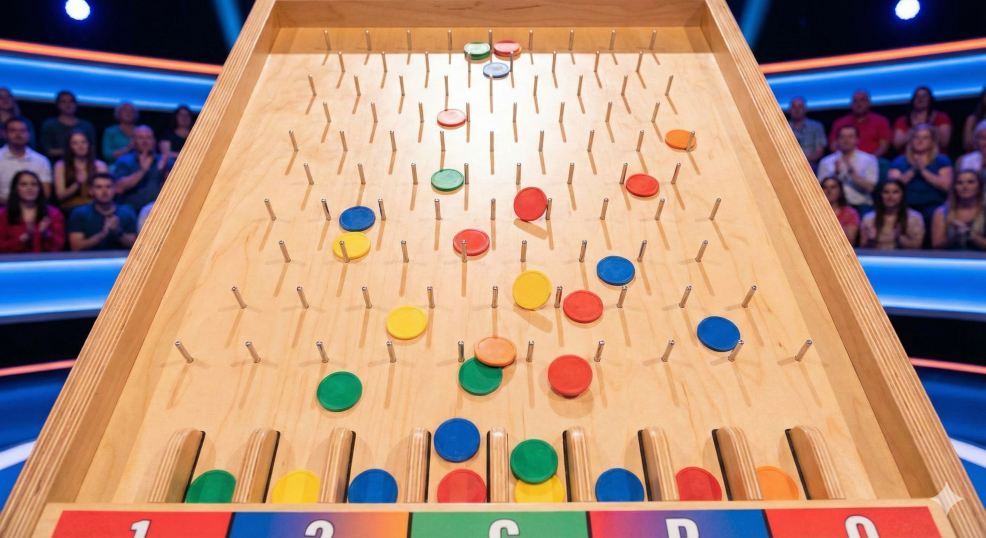
A ball drops from the top. It hits a peg. It bounces left. Then right. Then left again. You hold your breath. Where it lands is anyone’s guess.
That is the core of Plinko. And that core has not changed in over 140 years.
What started as a Victorian era probability experiment became one of Japan’s biggest entertainment industries, then the most popular segment in American game show history, and now one of the most played digital games on the planet. Platforms like the best plinko gambling site have turned the classic peg and ball concept into a modern physics driven experience that millions interact with daily. The journey of this simple game tells a bigger story about how timeless design survives every shift in technology.
Here is the full history, from wooden boards and steel balls to the screens in your pocket.
The Galton Board: Where It All Started (1874)
Before Plinko had a name, it had a formula.
In 1874, English polymath Sir Francis Galton presented a device to the Royal Institution in London. It was a vertical board with rows of pegs arranged in a staggered pattern. Small lead beads were dropped from the top. Each bead bounced randomly left or right as it hit the pegs, and eventually collected in bins at the bottom.
Every time he ran the experiment, the beads formed the same shape. A bell curve.
Galton called his device the “quincunx,” though it later became known as the Galton Board or bean machine. His goal was to demonstrate what statisticians now call the central limit theorem: even when individual outcomes are completely random, the aggregate result follows a predictable pattern. Each bead’s path was chaotic on its own, but thousands of beads together always settled into a smooth, symmetrical distribution.
The design was simple. A vertical surface, offset rows of pins, and gravity doing the work. That exact layout would reappear more than a century later in living rooms, arcades, and smartphones around the world. Galton likely never imagined his probability tool would become entertainment, but the mechanics he built were too satisfying to stay inside a laboratory.
Pachinko: Japan Takes the Peg Board Mainstream (1920s to Present)
Thousands of miles from Galton’s London lecture hall, a different version of the peg-and-ball concept was taking shape in Japan.
Pachinko traces its roots to the Corinth Game, a Western children’s toy that arrived in Nagoya around 1920. Players launched small balls using a spring mechanism and watched them bounce through a field of pins toward prize slots. Japanese manufacturers adapted this concept for adult audiences, and by the time the first commercial pachinko parlor opened in Nagoya after World War II, the game had become a cultural force.
The numbers tell the story. At its peak in the 1990s, roughly 30 million Japanese people played pachinko across more than 18,000 parlors nationwide. According to industry data from AGB and the National Police Agency, pachinko machines generated approximately 8.2 trillion yen ($53.1 billion) in 2023 alone, with pachislot machines adding another 7.5 trillion yen. The global pachinko market was valued at roughly $113 to $121 billion in 2025, according to multiple market research estimates.
Even with that scale, the industry is contracting. The number of parlors dropped to around 6,839 by the end of 2023, a decline of 526 from the year before. Operators fell by 11.1 percent in the same period. Masa Suganuma, CEO of ReNeA JAPAN and a veteran game development expert, described the trend bluntly in a 2025 interview with AGB: the player population has been shrinking, and younger generations are not replacing them.
Still, pachinko’s influence on game design is massive. It proved that a simple physics based mechanic, a ball bouncing through pins, could sustain an entire entertainment industry for nearly a century. That lesson was not lost on American television producers.
The Price Is Right: Plinko Becomes a Household Name (1983)
On January 3, 1983, host Bob Barker introduced a new pricing game on CBS’s The Price Is Right. Executive producer Frank Wayne had designed it. The concept was direct: contestants dropped a flat disc from the top of a large vertical board covered in pegs. The disc bounced unpredictably through the pegs and landed in one of nine prize slots at the bottom.
Wayne named it Plinko after the sound the disc made as it hit each peg. “Plink, plink, plink.”
The story goes that Wayne brought an actual pachinko board into a development meeting to pitch the idea to show creator Mark Goodson. Whether the inspiration was direct or indirect, the mechanical similarity was obvious. Both games used a vertical surface with offset pegs and relied on gravity and random deflection to determine the outcome.
At its 1983 debut, Plinko offered a top prize of $25,000, the largest amount CBS allowed on a game show at the time. The first contestant, Judy Ridenour, walked away with $6,500. The audience reaction made it clear that something had clicked. Plinko quickly became the most requested and most beloved segment on the show.
Over the next four decades, the game evolved in small ways. CBS raised the maximum prize to $50,000 in 1984 and kept increasing it. A plexiglass cover was added in 1991 after chips occasionally bounced off the open board onto the stage. The Plinko board was redesigned with triangular holes in 1994 to prevent chips from getting stuck. In 2013, the show dedicated an entire episode to Plinko to celebrate the game’s 30th anniversary.
But the fundamental design never changed. Drop a disc. Watch it bounce. Hope for the best. That simplicity is exactly what made Plinko work on television and what would later make it work everywhere else.
The Physics Behind the Fun
Plinko’s appeal is not random. It is rooted in probability theory and basic physics in a way that people can feel even if they cannot explain it.
Every time a disc or ball hits a peg, it deflects in one of two directions. That single collision is essentially a coin flip. But each drop involves many such collisions, sometimes eight, sometimes sixteen depending on the number of rows. The final landing position is the sum of all those random deflections.
This is exactly what Galton demonstrated in 1874. The probability of a ball landing in any given slot follows a binomial distribution. With enough rows and enough drops, the results approximate a bell curve. Balls tend to cluster in the center slots, while the extreme edges are statistically rare.
That mathematical reality creates the emotional experience. Center slots feel safe. Edge slots feel like long shots. And every bounce between the two builds tension because the viewer can see the math playing out in real time, even if they do not think of it that way.

Dr. Raymond Hall, a professor of physics at California State University, Fresno, has used Galton Boards extensively in physics education. The device remains one of the most effective tools for teaching probability, precisely because people can watch abstract statistical concepts happen physically right in front of them. Plinko leverages that same visual power, but wraps it in entertainment.
Game designers have long understood this. The best games communicate their rules through action, not explanation. Plinko does that perfectly. You do not need to read instructions. You watch the ball drop and you understand.
Arcade Redemption and the Physical Plinko Board
Outside of television, Plinko boards became staples of trade shows, charity fundraisers, carnivals, and corporate events throughout the 1990s and 2000s. Custom built boards with branded prize slots turned the game into a marketing tool. Companies like Pop49 now manufacture commercial Plinko boards with interchangeable panels, custom colors, and branded prize options.
In arcades, the peg and ball mechanic showed up in various redemption games where players earned tickets based on where a ball or token landed after bouncing through a pin field. These games borrowed directly from Plinko’s visual language: a vertical board, staggered pegs, and variable prize zones at the bottom.
The University of Nebraska Lincoln took it further in 2021, constructing a Plinko board over 40 feet tall as a physics demonstration. The project illustrated the same principles Galton had shown nearly 150 years earlier, just at a scale that could fill an auditorium.
What all these applications had in common was the physical reality of the game. Real gravity. Real collisions. Real unpredictability. That tactile quality is part of what made Plinko so difficult to translate into digital form for so long.
Going Digital: Plinko on Screens (2010s to 2026)
Plinko’s digital transformation happened later than you might expect. Despite online gaming emerging in the late 1990s, credible digital Plinko versions did not appear until the mid 2010s. The reason was straightforward: recreating convincing ball physics on screen is harder than it looks.
A physical Plinko board has real gravity, real friction, and real elasticity. Each collision between a ball and a peg involves forces that are easy to experience but complex to simulate. Early digital attempts felt flat because the ball movements looked predetermined rather than genuinely random.
That changed as physics engines improved. Modern digital Plinko uses custom simulations that model gravity, friction, and energy transfer to produce ball movements that feel authentic. Some platforms use blockchain based random number generators to determine outcomes, adding a layer of cryptographic verification to the process. These are called provably fair systems, and they allow players to independently verify that results have not been manipulated.
The row count is significant from a mathematical standpoint. Eight rows mean the ball makes eight binary deflections, resulting in nine possible landing positions. Sixteen rows produce seventeen positions and a much wider distribution. More rows mean more variance, which translates to higher potential multipliers at the edges but lower probability of reaching them.
This adjustability is what separates digital Plinko from its television ancestor. On The Price Is Right, the board was fixed. Everyone played the same layout. Digital versions give the player control over the very parameters that shape the probability curve. It is the same core game, but with the math exposed as a feature rather than hidden as a constraint.
Why Plinko Survived Every Era
Most games have a lifespan. They emerge, peak, and fade. Plinko has been relevant for over 40 years in its modern form and over 140 years if you count the Galton Board. That longevity is not accidental.
Frank Wayne understood something fundamental when he designed Plinko for television: the game needed no explanation. A ball drops through pegs. It lands somewhere. You win or you do not. There are no rules to memorize, no strategies to master, and no skills to develop. The entire experience is compressed into a few seconds of watching and hoping.
That design philosophy maps directly onto what modern game designers call “low floor, high ceiling” mechanics. The barrier to entry is zero. Anyone can understand what is happening. But the emotional engagement scales with the stakes, the context, and the presentation.
Sid Meier, the legendary game designer behind the Civilization series, once said that a game is a series of interesting decisions. Plinko challenges that idea. It offers almost no decisions at all. Where you drop the ball might change the odds slightly, but the outcome is fundamentally random. Yet Plinko generates more emotional engagement per second than most decision heavy games ever achieve. That tells us something important about game design: sometimes the anticipation of an outcome is more engaging than the outcome itself.
Pachinko proved this in Japan for a century. The Price Is Right proved it on American television for four decades. And digital platforms are proving it again right now. The format changes. The screens change. The technology changes. But the core experience, watching a ball bounce through pegs while hoping for the best, has not changed since 1874.
The Design Lesson That Keeps Repeating
There is a pattern in gaming history that Armchair Arcade readers will recognize. The most enduring game concepts are the simplest ones. Tetris is falling blocks. Pac Man is eating dots. Pong is bouncing a ball. Plinko is dropping one.
These games survive because their mechanics communicate instantly and their outcomes generate emotion without complexity. They do not rely on graphics, narrative, or technology. They work on a wooden board in 1874. They work on a CBS soundstage in 1983. They work on a phone screen in 2026.
The history of Plinko is really the history of one idea moving through time: let gravity and randomness create a spectacle, and people will watch. They always have. They probably always will.
What has changed is the infrastructure around that idea. Digital physics engines make the ball feel real. Cryptographic systems make the randomness verifiable. Adjustable parameters give players control over the math. But underneath all of that, the game is still what Galton built 150 years ago. A board, some pegs, and a ball that could go anywhere.
That is a good game. And good games do not expire.




 Your total news and information resource for all things Science, Technology, Engineering / Mathematics, Art, and Medicine / Health.
Leave a Comment