

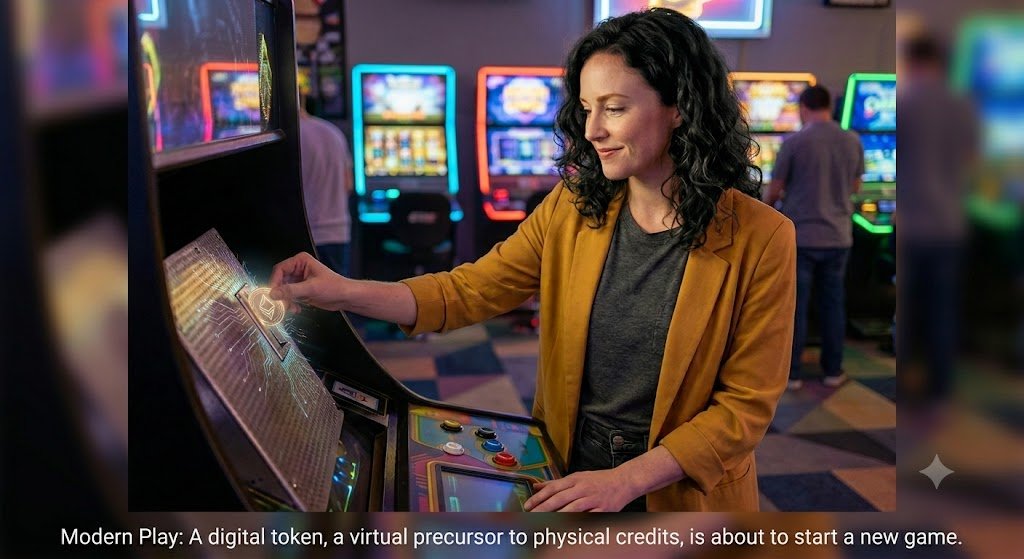
Walk into any old-school arcade and the first thing that hits you is the jingle of metal. Quarters dropping, tokens clinking into change machines, the satisfying clunk of a coin sliding into a Pac-Man or Galaga cabinet. For decades, that small metal disc was the universal key to instant fun. You traded a dollar for a stack of brass tokens and suddenly held the power to challenge a high score, sink a free throw on a hoop machine, or feed the gaping mouth of a Skee-Ball lane. The token was simple, physical, and gloriously direct. Today, that same idea of “drop a token, get a turn” has migrated through swipe cards, console wallets, and even digital ledgers, a journey that would have seemed like science fiction to anyone clutching a paper cup full of quarters.
That migration shows up most clearly in the world of on-chain gaming, where tokens are no longer brass but code, and the action plays out across digital ledgers instead of CRT screens. For anyone curious about how this newer corner has organized itself, a crypto casino online ranking serves as a kind of living directory, sorting Web3 gaming destinations by transaction volume, active wallets, chain support, and overall transparency. These continuously updated lists cover everything from blockchain-based gaming sites to Web3 sportsbooks and prediction markets, and they cater to people who prefer no-KYC entry points. The appeal is easy to grasp for anyone raised on arcade culture: it offers a quick, verifiable way to see where the crowds are gathering and which destinations actually deliver on what they promise, the same way a busy arcade once signaled which cabinets were worth the wait.
The Golden Age of the Token
The token economy of the arcade era was a small marvel of design. Operators figured out early that a custom token kept money inside the building, discouraged theft, and turned spending into a smoother, almost frictionless habit. A kid with a fistful of tokens wasn’t thinking about dollars anymore; the tokens became their own little currency, spent freely on whatever cabinet lit up brightest.
That psychology, dressing up money as play-currency, has a long pedigree. Coin-operated machines predate the video arcade by generations, stretching back to mechanical fortune-tellers, player pianos, and the earliest slot devices. The Strong National Museum of Play documents this lineage in its exhibit on coin-operated games, tracing how the act of inserting a coin became one of the most universal gestures in modern entertainment. From Computer Space to Street Fighter II, the gesture stayed the same even as the games grew dramatically more sophisticated.
When Tokens Went Digital
The first big shift away from metal tokens came quietly, through magnetic-stripe cards. Chains like Dave & Buster’s swapped brass for plastic, loading credits onto a card that you tapped against a reader. The clinking sound faded, but the underlying logic held firm: convert real money into a closed-loop credit, then spend that credit on play.
Home consoles pushed the idea further. Microsoft Points, PlayStation wallet funds, and the in-game currencies of countless titles all descend directly from the arcade token. Even a modern hit like Balatro leans on the timeless thrill of stacking up a score against a clear, visible target, the same dopamine loop the arcade perfected. The token never really disappeared. It just became abstract, living inside software rather than a coin slot.
Crypto Tokens and the On-Chain Turn
The newest chapter takes that abstraction to its logical extreme. On a blockchain, a token is a unit of value recorded on a public ledger that anyone can inspect. Instead of trusting an operator to honor your plastic card balance, the ledger itself keeps the record, visible to all and difficult to fudge.
This matters for gaming because it changes what players can verify. The economics behind these systems can get genuinely complex, as research into the volatility of gaming crypto tokens lays out in detail, examining how both on-chain and off-chain factors shape the returns and liquidity of digital gaming currencies. For the retro enthusiast, the fascinating part is the through-line. The arcade operator who minted custom tokens to control an economy and the developer who issues an on-chain token are solving versions of the same puzzle: how to make a unit of fun feel trustworthy, scarce, and worth spending.

The Collector’s Instinct Carries Over
Anyone who has hunted down a sealed copy of EarthBound or chased a complete Evercade cartridge set understands the collector’s itch. That same instinct now drives interest in digital items recorded on-chain, where ownership is logged rather than stored in a display case. The objects are different, but the impulse to own something verifiable and rare is identical.
History museums have noticed how deeply this collecting culture runs through coin-operated entertainment. The SFO Museum’s look at the automatic age of coin-operated machines showcases gorgeously engineered devices that people now treasure as artifacts. A century ago, a nickel bought a moment of mechanical wonder. Today, those same machines sit behind glass, prized by collectors who appreciate the craft. The fun was always temporary, but the fascination with the hardware, and the systems behind it, has proven remarkably durable.
Same Spark, New Slot
What ties all of this together is the human desire for a quick, contained burst of excitement, paid for with a token that feels separate from everyday money. The brass disc, the swipe card, the in-game credit, and the on-chain token are all answers to one persistent question: how do you turn a small payment into a moment of play? The arcade answered it with a coin slot and a high-score table. The current generation answers it with wallets, ledgers, and code. The technology keeps reinventing itself, yet the feeling at the heart of it, drop the token, take your turn, has barely changed at all.



 Your total news and information resource for all things Science, Technology, Engineering / Mathematics, Art, and Medicine / Health.
Leave a Comment